CPR and AED defibrillators: how to be ready to save a life
⏱ 3 min read
Course, steps, defibrillator. A guide based on official advice. The same text is in the free SurvivalZone.app and works without internet.
When someone suddenly collapses and is not breathing normally, minutes count. Their chances usually depend on bystanders who start chest compressions and use a defibrillator before the ambulance arrives.
Most people do not help because they are afraid of doing it wrong. The best cure for that fear is a short course.
A first aid course
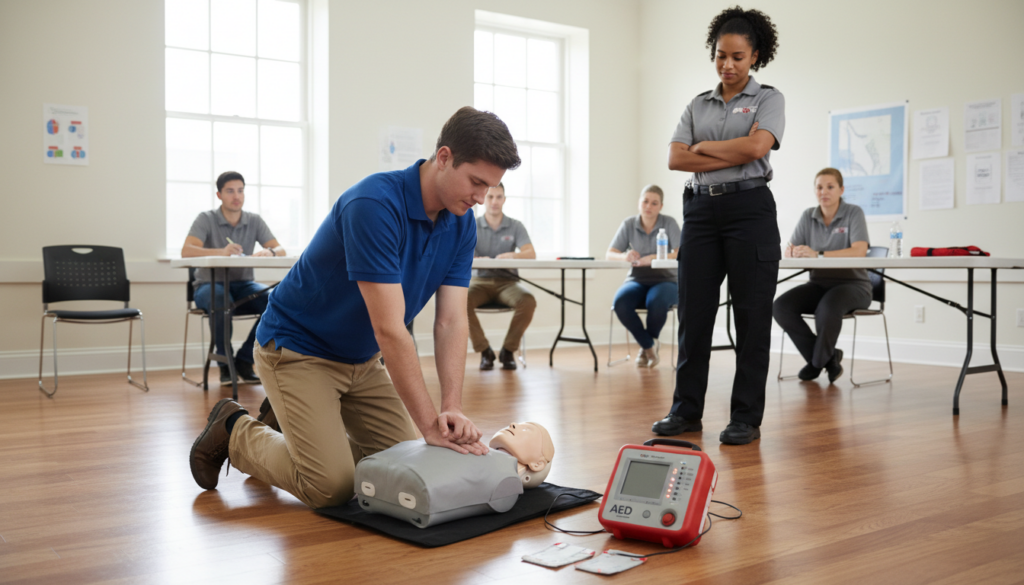
- A first aid course usually takes a few hours. They are run by the Red Cross, St John Ambulance, paramedics and training centres. Practising on a manikin teaches the most: you feel how hard and fast you need to push.
- Guidelines change every few years, so it is worth refreshing your skills.
What to remember
- Check whether the person responds and is breathing normally.
- Call 112, or ask someone else to, and to bring an AED.
- Push hard and fast in the centre of the chest, about 100 to 120 times a minute.
- The 112 call handler will guide you step by step.
The AED defibrillator
- An AED tells you what to do. You cannot hurt anyone with it, because it only gives a shock when one is needed. AEDs hang in green and white cabinets at stations, offices, shopping centres and more and more schools.
- Find out where the nearest AED is near your home and work. You can see them on the help map in SurvivalZone.app.
At home
- If someone in your family has a heart condition, talk about what to do in an emergency. Save a medical card with conditions and medicines on your phone, so paramedics have it at hand.
Checklist
- A first aid course
- The sequence remembered: response, 112, compressions
- Nearest AED to home found
- Nearest AED at work found
- A medical card on your phone
- A family talk about emergencies
See also
Frequently asked questions
Can I hurt someone by doing CPR?
Doing nothing is far more dangerous. A person who is not breathing will die without chest compressions. The 112 call handler will help you step by step.
Can anyone use an AED?
Yes. The device tells you what to do and only gives a shock when it is needed.
Where can I find the nearest AED?
On the help map in SurvivalZone.app. Also look for green signs with a heart and a lightning bolt.
📩 Free 72-hour plan by email
A 72-hour shopping and go-bag list, plus a short monthly checklist. Free, no spam.
Keep it on your phone
SurvivalZone.app is a free app for every emergency, with no account and no app store. It works without internet and shows the nearest shelters and help points, local radio, a 72-hour plan and a mountain trip planner.
Thank you for reading. If this could help someone, send it to the people you care about. Getting ready takes a moment, and in a crisis every minute counts.
Coming soon: the app’s permanent address will be survivalzone.app.
Other guides
- 💧 How to make water safe
- 🍲 Food without power
- ⛺ Shelter at home and outdoors
- 👨👩👧 Protecting your family and yourself
- 💊 Run out of medicine
- 🎒 Go bag checklist
- 🩹 Home first aid kit
- 🔦 Prepare your home for a blackout
- ✈️ Air travel: a safe trip
- 🏜️ Desert trip
- 🪢 Knots worth knowing
- 🔥 Campfire and outdoor cooking
- 🧭 Survival kit for your backpack
- 📞 Family communication plan
- 🥫 Emergency food and medicine supplies
- 🧼 Hygiene in a crisis
- 📁 Documents and money in a crisis
- 🧰 Tools and equipment for a crisis
- 🧥 Clothing and warmth in a crisis
- 📻 Communication and navigation in a crisis
- 🥶 Home ready for frost
- 🌊 Prepare your home for floods
- 🔥 Fire safety at home
- 🌡️ Get ready for a heatwave
- ⛈️ Storm-proof your home
- 🚀 Shelter for an air raid
- 📢 Sirens and alerts
- 🌍 Prepare for earthquakes
- ⛵ Safe sailing at sea
- 🚗 Car ready for an accident
- ☠️ Carbon monoxide and gas alarms
- ❄️ Winter car kit
- 🌩️ Mountain storms: plan your hike
- 🫀 Heart attack and stroke signs
- 🏊 Water safety
- 🌲 Prevent wildfires
- 🦠 Prepare for an epidemic or pandemic
- 🧒 If your child gets lost
- 🫁 Prevent choking
- 🩸 Kit for severe bleeding
- 🔥 Prevent burns
- 😷 Smog: protect your health
- 🐻 Bears: avoid encounters
- 🐗 Wild boar: avoid encounters
- 🏢 Evacuation at work
- 🌪️ Shelter from a tornado
- 🌧️ Protect your basement from flash floods
- ☣️ Chemical incident: prepare your home
- 🏠 Quarantine at home
- 🛡️ Secure your phone and accounts
- 🔌 Your fuse box: get ready in advance
- 💨 Gas at home: a safe installation
- 😵💫 Fainting: how to prevent it
- 🏫 School and emergencies: prepare your child and family
- 🏜️ Drought: how to prepare your home and garden
- 🌋 Travelling near volcanoes: how to prepare
- 🛴 Riding an e-scooter safely
- 🛑 Attacker at school: how to prepare your child
- 🔔 Smoke and CO alarms: a home ready for the alarm
- 🔥 Campfire: types and ways to light one
Sources
- Polish government safety guide (MON, MSWiA, RCB, 2025)
- BBK guide "Vorsorgen für Krisen und Katastrophen" (Germany)
Official sources are checked automatically every day. Last check: 2026-11-04.
General guidance only; it does not replace the emergency services. If a life is in danger, call 112.