Flooding: how to check your risk and prepare your home before the water comes
⏱ 3 min read
Risk map, documents, when to leave. A guide based on official advice. The same text is in the free SurvivalZone.app and works without internet.
The floods in Central Europe in September 2024 showed how quickly water can reach places that had been dry for decades. Many people had only a few hours to decide what to take and whether to leave.
The good news is that you can check your flood risk in advance, and most preparation costs nothing.
Check whether you live in a flood zone
- Most European countries publish official flood risk maps, usually from the national environment or water agency. Check whether your home, your route to work and your children's school are in a flood zone. Remember that flash floods after heavy rain can happen far from rivers.
Prepare your home
- Know how to turn off electricity, gas and water, and show every adult in the house.
- Keep valuables, electronics and chemicals high up, especially in basements and on the ground floor.
- Consider non-return valves on drains, so water cannot back up into the house.
- Check your insurance: does it cover flooding, and what do you need to do to claim?
Documents and a grab bag
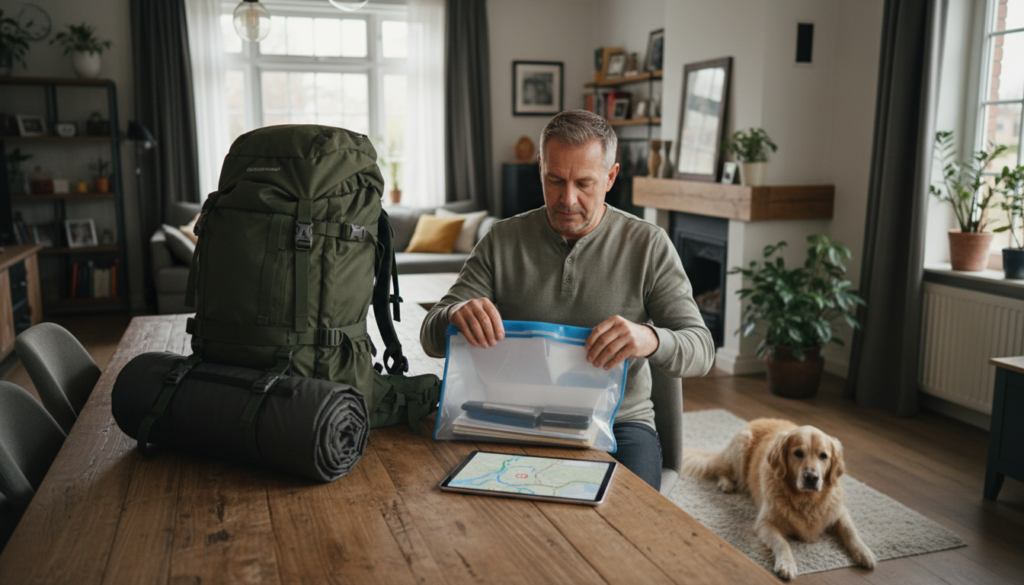
- Keep ID, property papers, insurance policies and medical records in a waterproof folder, with photos or scans stored safely online. Pack a grab bag for each person: water, food, medicines, charger, torch and a change of clothes.
When to leave
- Follow flood warnings from your national weather or environment service and your local council. When the authorities advise evacuation, leave straight away. Later the roads may be flooded, and driving through water is one of the most common causes of death in floods.
- Decide in advance where you will go: to family, friends or a place named by the council. Think about your pets.
Checklist
- Flood risk map checked
- Every adult knows how to turn off power, gas and water
- Valuables moved higher
- Documents in a waterproof folder, plus scans
- A grab bag for each person
- A place to go agreed
- Insurance policy checked
- A plan for pets
See also
- 🌊 Flood, water coming in
- 🎒 Go bag checklist
- 📁 Documents and money in a crisis
- 📞 Family communication plan
Frequently asked questions
How do I check if my home is at risk of flooding?
Look at the official flood risk maps for your country, usually published by the environment or water agency, and ask neighbours whether the area has flooded after heavy rain.
What should I take when evacuating before a flood?
Documents, medicines, phone and charger, water, food, warm clothes and things for children and pets. A packed grab bag is best.
Can I drive through floodwater?
No. Fast-flowing water only a few tens of centimetres deep can sweep a car away. Turn around and find another route.
📩 Free 72-hour plan by email
A 72-hour shopping and go-bag list, plus a short monthly checklist. Free, no spam.
Keep it on your phone
SurvivalZone.app is a free app for every emergency, with no account and no app store. It works without internet and shows the nearest shelters and help points, local radio, a 72-hour plan and a mountain trip planner.
Thank you for reading. If this could help someone, send it to the people you care about. Getting ready takes a moment, and in a crisis every minute counts.
Coming soon: the app’s permanent address will be survivalzone.app.
Other guides
- 💧 How to make water safe
- 🍲 Food without power
- ⛺ Shelter at home and outdoors
- 👨👩👧 Protecting your family and yourself
- 💊 Run out of medicine
- 🎒 Go bag checklist
- 🩹 Home first aid kit
- 🔦 Prepare your home for a blackout
- ✈️ Air travel: a safe trip
- 🏜️ Desert trip
- 🪢 Knots worth knowing
- 🔥 Campfire and outdoor cooking
- 🧭 Survival kit for your backpack
- 📞 Family communication plan
- 🥫 Emergency food and medicine supplies
- 🧼 Hygiene in a crisis
- 📁 Documents and money in a crisis
- 🧰 Tools and equipment for a crisis
- 🧥 Clothing and warmth in a crisis
- 📻 Communication and navigation in a crisis
- 🥶 Home ready for frost
- 🔥 Fire safety at home
- 🌡️ Get ready for a heatwave
- ⛈️ Storm-proof your home
- 🚀 Shelter for an air raid
- 📢 Sirens and alerts
- ❤️ Learn CPR and find an AED
- 🌍 Prepare for earthquakes
- ⛵ Safe sailing at sea
- 🚗 Car ready for an accident
- ☠️ Carbon monoxide and gas alarms
- ❄️ Winter car kit
- 🌩️ Mountain storms: plan your hike
- 🫀 Heart attack and stroke signs
- 🏊 Water safety
- 🌲 Prevent wildfires
- 🦠 Prepare for an epidemic or pandemic
- 🧒 If your child gets lost
- 🫁 Prevent choking
- 🩸 Kit for severe bleeding
- 🔥 Prevent burns
- 😷 Smog: protect your health
- 🐻 Bears: avoid encounters
- 🐗 Wild boar: avoid encounters
- 🏢 Evacuation at work
- 🌪️ Shelter from a tornado
- 🌧️ Protect your basement from flash floods
- ☣️ Chemical incident: prepare your home
- 🏠 Quarantine at home
- 🛡️ Secure your phone and accounts
- 🔌 Your fuse box: get ready in advance
- 💨 Gas at home: a safe installation
- 😵💫 Fainting: how to prevent it
- 🏫 School and emergencies: prepare your child and family
- 🏜️ Drought: how to prepare your home and garden
- 🌋 Travelling near volcanoes: how to prepare
- 🛴 Riding an e-scooter safely
- 🛑 Attacker at school: how to prepare your child
- 🔔 Smoke and CO alarms: a home ready for the alarm
- 🔥 Campfire: types and ways to light one
Sources
- Polish government safety guide (MON, MSWiA, RCB, 2025)
- BBK guide "Vorsorgen für Krisen und Katastrophen" (Germany)
Official sources are checked automatically every day. Last check: 2026-11-04.
General guidance only; it does not replace the emergency services. If a life is in danger, call 112.