How to stop severe bleeding: first aid step by step
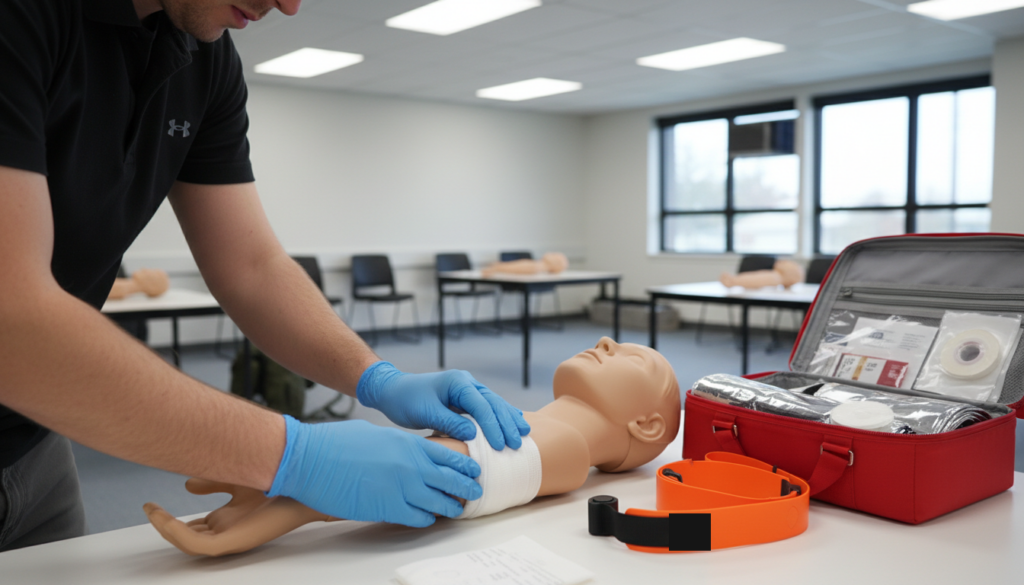
Blood is spurting or will not stop. Below: what to do right away, what next, when to call 112 and what to avoid. The same instructions are in the free SurvivalZone app and work without internet.
First, right now
- Call 112, or get someone to, and put the phone on speaker so you can hear the dispatcher.
- Put on gloves if you have them. Press firmly on the wound with your hand over a dressing, gauze or clean cloth, and keep pressing.
- Lay the person down. If bleeding from an arm or leg does not stop with pressure, apply a tourniquet.
Then
- Pack a deep wound with gauze, ideally a haemostatic dressing, and keep pressing hard.
- Once the bleeding stops, apply a pressure bandage: several layers of gauze and a firmly wrapped bandage.
- Place the tourniquet 5–7 cm above the wound, not over a joint. Tighten it until the bleeding stops and write down the time.
- If one tourniquet is not enough, apply a second one above the first.
- Cover the person with a foil blanket or a blanket and keep talking to them until help arrives.
When to call 112
Always when blood is spurting or pulsing, or does not stop despite pressure, and with heavy blood loss, pale skin, cold sweat, confusion or drowsiness.
What not to do
- Do not loosen or remove a tourniquet. Only healthcare staff may do this.
- Do not pull out objects stuck in the wound, such as a knife or a rod. Press around them and keep them still.
- Do not remove a soaked dressing. Put another one on top and keep pressing.
- Do not press on so-called pressure points instead of the wound. Guidelines recommend pressing directly on the wound.
See also
Frequently asked questions
When should I use a tourniquet?
For life-threatening bleeding from an arm or leg that firm direct pressure does not stop. Place it 5–7 cm above the wound, not over a joint, and note the time.
What if I have no dressing?
Press on the wound with any clean material, such as a T-shirt, towel or scarf. What matters most is firm, continuous pressure.
Can I loosen the tourniquet to rest the limb?
No. Only healthcare staff should remove a tourniquet.
Keep it on your phone
SurvivalZone is a free app for every emergency, with no account and no app store. It works without internet and shows the nearest shelters and help points, local radio, a 72-hour plan and a mountain trip planner.
Thank you for reading. If this could help someone, send it to the people you care about. Getting ready takes a moment, and in a crisis every minute counts.
Coming soon: the app’s permanent address will be survivalzone.app.
Other scenarios
- ⚡ Power cut
- 🥶 Cold, no heating
- 🚱 No water or unsafe tap water
- 🌊 Flood, water coming in
- 🎒 Evacuation in 10 minutes
- 🔥 Fire in the building
- 🌡️ Heatwave
- 🌪️ Storm, strong wind
- 🚀 Air attack: missiles, drones, bombs
- 📢 Sirens, alarm, air contamination
- 📵 No signal, no internet
- ❤️ Someone is unconscious
- 🌍 Earthquake
- ⛵ Storm at sea, no internet
- 🚗 Road accident
- ☠️ Carbon monoxide or gas leak
- ❄️ Stuck in a car in a snowstorm
- 🌩️ Thunderstorm outdoors
- 🫀 Heart attack or stroke
- 🏊 Someone is drowning
- 🌲 Forest or grass fire
- 💳 Cards and cash machines not working
- 🦠 Epidemic, dangerous infectious disease
- 🧒 A child is missing
- 🫁 Choking
- 🔥 Burns and scalds
- 😷 Smog and poor air quality
Sources
- ERC Guidelines 2025 (European Resuscitation Council)
- ERC Guidelines 2021: First aid (Resuscitation, 2021)
- ILCOR 2025: First Aid Consensus on Science (CoSTR)
- Resuscitation Council UK: First aid guidelines 2025
- Polish Resuscitation Council: "Resuscitation for everyone", ERC 2025 (in Polish)
Official sources are checked automatically every day. Last check: 2026-10-22.
General guidance only; it does not replace the emergency services. If a life is in danger, call 112.