Earthquake: what to do, step by step
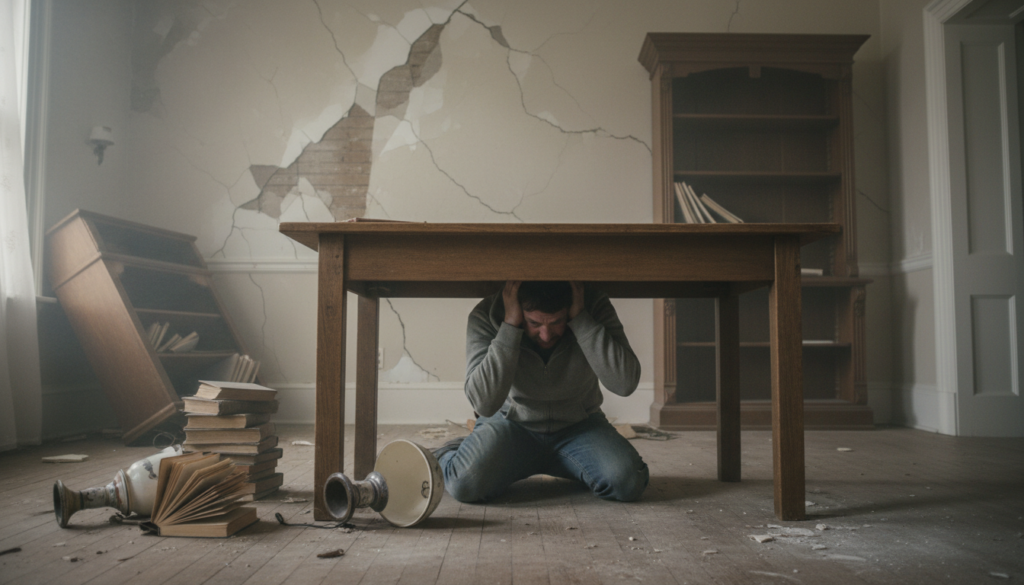
The ground is shaking. Below: what to do right away, what next, when to call 112 and what to avoid. The same instructions are in the free SurvivalZone app and work without internet.
First, right now
- DROP to your hands and knees right where you are.
- COVER your head and neck: get under a sturdy table or desk. No table? Get down next to an inside wall, away from windows, and cover your head with your arms.
- HOLD ON until the shaking stops. If you are in bed, stay there and cover your head with a pillow.
Then
- Outside: move to an open space away from buildings, trees, street lights and power lines, then drop down.
- In a car: stop in a safe place away from bridges, tunnels and buildings, and stay inside with your seat belt on.
- When it stops, check yourself and others for injuries. Put on shoes, because there will be broken glass.
- Expect aftershocks. They can come minutes, hours or days later. Drop, cover and hold on again each time.
- Smell gas? Don't switch anything on or off and don't light anything. Open the door, leave and tell the gas emergency line or 112 from outside.
- If the building is damaged, leave carefully by the stairs and stay away from it.
- Near the coast after a strong or long earthquake: go to high ground or far inland at once. Don't wait for an official warning, a tsunami can arrive within minutes.
- Send text messages instead of calling, and listen to the radio for official information.
How strong is it? (magnitude)
| below 4 | Usually felt only a little. Things may rattle. No damage. |
| 4–4.9 | Felt by most people. Things fall off shelves. Damage is rare. |
| 5–5.9 | Damage to weak and old buildings. Cracks in walls. |
| 6–6.9 | Serious damage in towns near the centre. |
| 7 and more | Major damage over a wide area. On the coast: tsunami risk, go to high ground. |
Magnitude says how much energy the earthquake released. What you feel depends on how far you are from the centre and on the ground and buildings around you.
When to call 112
Someone is trapped, badly injured or not breathing, you smell gas, or there is a fire.
What not to do
- Don't run outside while the ground is shaking. Most injuries come from falling glass and parts of buildings.
- Don't stand in a doorway. In modern buildings it is not safer and the door can hit you.
- Don't use the lift.
- Don't go back into a damaged building until it has been checked.
See also
Keep it on your phone
SurvivalZone is a free app for every emergency, with no account and no app store. It works without internet and shows the nearest shelters and help points, local radio, a 72-hour plan and a mountain trip planner.
Other scenarios
- ⚡ Power cut
- 🥶 Cold, no heating
- 🚱 No water or unsafe tap water
- 🌊 Flood, water coming in
- 🎒 Evacuation in 10 minutes
- 🔥 Fire in the building
- 🌡️ Heatwave
- 🌪️ Storm, strong wind
- 🚀 Air attack: missiles, drones, bombs
- 📢 Sirens, alarm, air contamination
- 📵 No signal, no internet
- ❤️ Someone is unconscious
- ⛵ Storm at sea, no internet
- 🚗 Road accident
- ☠️ Carbon monoxide or gas leak
- ❄️ Stuck in a car in a snowstorm
- 🌩️ Thunderstorm outdoors
- 🫀 Heart attack or stroke
- 🏊 Someone is drowning
- 🌲 Forest or grass fire
- 💳 Cards and cash machines not working
- 🦠 Epidemic, dangerous infectious disease
- 🧒 A child is missing
Sources
- USGS: earthquake hazards
- BBK guide "Vorsorgen für Krisen und Katastrophen" (Germany)
- ERC first aid and resuscitation guidelines (European Resuscitation Council)
Official sources are checked automatically every day. Last check: 2026-10-18.
General guidance only; it does not replace the emergency services. If a life is in danger, call 112.